
On this first day of May, the budget and other “must pass” bills are on track to pass ahead of schedule, but legislators won’t be done with their work until the education transformation package is finalized (see Public Assets’ resource hub for more information about this). This means there is still time for lawmakers to continue wrapping up other priority bills, and perhaps find new things to work on as well over the next month.
In case you missed it, Common Good Vermont hosted Nonprofit Legislative Day at the State House last week. You can read the recap here.
Read on for:
- State Funding
- Budget & Appropriations
- Miscellaneous
- H. 461 – An act relating to expanding employee access to unpaid leave
- S. 27 – An act relating to medical debt relief and excluding medical debt from credit reports
- S. 148 – An act relating to expanding good samaritan protections concerning immigration
- H. 379 – An act relating to second look sentencing
State Grants & Contracts
H. 233 – State Grants Bill
The House Government Operations Committee has continued its work on H. 233. In response to pushback from the administration, the bill has been scaled back significantly to an “informal” working group. In Draft 2.1, the membership of the working group would include a representative from the regional planning commissions, a representative from Common Good Vermont, and the Secretary of Administration or a designee. The scope of the working group has also been made more vague/limited, with the entities being tasked with developing recommendations on:
- a requirement that all state agencies accept indirect rates approved by a federal/state agency
- a uniform indirect rate calculation methodology and approval process for use in all state-administered grants for nonprofit corporations of the state higher than the standard de minimis rate
- rule and process changes needed for efficient and predictable granting and contracting
- and any other issues that result from discussions
While the last two bullets provide room for the group to explore other challenges nonprofits face such as reimbursement grants, delayed contract execution, and underfunding, with limited nonprofit representation on the working group, no required number of meetings, and no requirement to cover these topics, there is no guarantee.
In the interest of passing H. 233 this year, Common Good proposed the following revisions that would give the bill enough teeth for it to be worth moving forward with:
- Given the limited requirements for the working group and limited representation on it, we would like to add a new section with language along the lines of: “The entities shall take testimony from relevant stakeholders including but not limited to nonprofits who have been awarded a grant within the past year.”
- Revise Section 1(b)(4) to read: “(4) rule and process changes needed for efficient and predictable granting and contracting, including but not limited to advance payments, grant agreement execution, and payment schedules; and”
On Wednesday, the committee heard again from the Administration, as well as from Common Good Vermont on the above proposed changes. The Administration does not support the working group, particularly the provision that requires the group to make recommendations to committees including for statutory changes (they prefer to make changes as needed to Bulletin 5 on their own). However, Secretary Clark did commit to taking on similar work this summer. The Secretary mentioned listening sessions or an advisory group as a way for her team to better understand the root causes of challenges.
The Committee is considering how to proceed at this time.
H. 13 – Medicaid payment rates for home- and community-based service
providers
On 4/29, the House concurred with the Senate’s amendments to H. 13, a bill that addresses payment rates for community-based providers, so it is now headed to the Governor’s desk. While the bill is limited to payment rates for community-based providers, Common Good would like to see similar payment calculations that factor in cost of living and the cost of goods applied to grant/contract funding levels. If H. 233 passes, this is something for the working group to explore.
Budget & Appropriations
FY26 Budget – “The Big Bill”
The FY26 Budget is on the Senate calendar this week after being voted out by Senate Appropriations. Once passed by the Senate, it will head to a committee of conference where both chambers will hammer out their differences. Please find information about the budget as recommended by the Senate Appropriations Committee below.
Overview documents:
- H.493 – Senate Appropriations Budget Highlights
- H.493 – FY 2026 State Budget – As Recommended By the Senate Committee on Appropriations
- H.493 – Senate One-time Appropriations Overview
- H.493 – Senate Base Changes
- More budget documents
Some pieces of note:
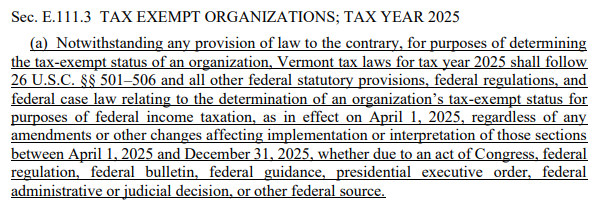
- Clarification regarding tax exempt status for TY25 in case of federal changes:
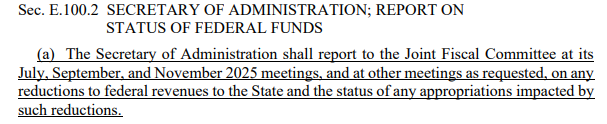
- Updated process for appropriation adjustments, such as in the case of federal funding cuts when the legislature is not in session, can be found starting on page 71 of the budget here. Additionally:
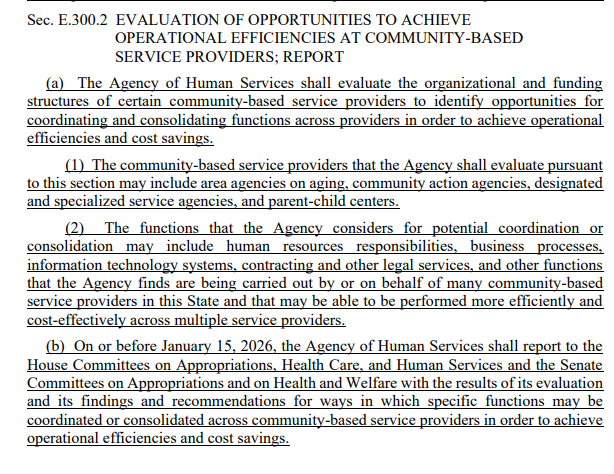
- AHS tasked with evaluating efficiency of community based service providers.
- DCF would be required to report on cost of a 1% increase to direct service providers.

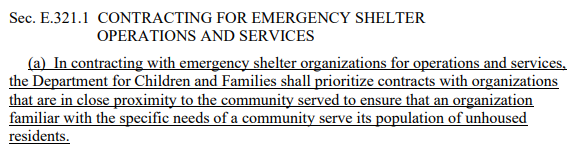
- DCF shall prioritize contracting with local organizations for emergency shelter needs.
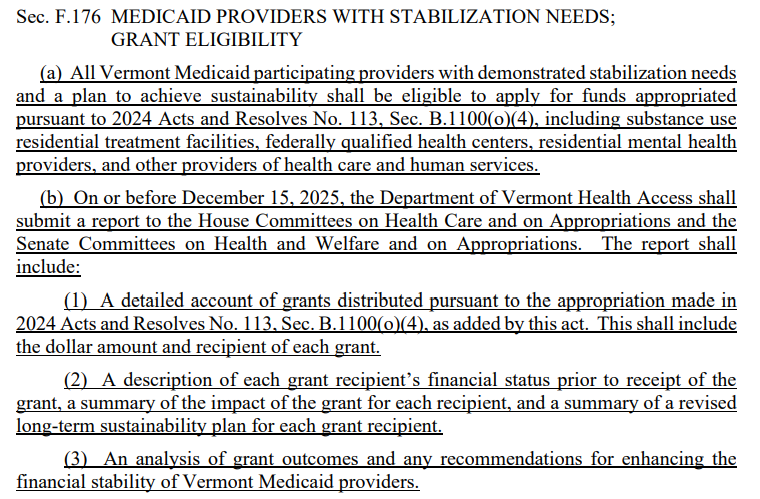
- The Department of Vermont Health Access is required to report on grants made to Medicaid providers and recommendations for enhancing the financial stability of providers.
- FY26 General Assistance Emergency Housing language can be found on page 98 of the budget draft.
H. 218 – An act relating to fiscal year 2026 appropriations from the Opioid Abatement Special Fund
H. 218 was passed by the Senate and has been messaged back to the House with one minor technical amendment. The bill proposes to appropriate $9,888,210 from the Opioid Abatement Special Fund for use in fiscal year 2026. Specific appropriations, including to nonprofits, can be found here.
Miscellaneous
H. 461 – An act relating to expanding employee access to unpaid leave
The Senate Economic Development Committee voted out an amended version of H. 461 (4-1-0) on 4/30. The bill expands the definitions of unpaid leave types including bereavement leave, family leave, and parental leave. It also adds a new type of leave – “safe leave” – which covers instances where leave is required for reasons related to domestic violence, sexual assault, or stalking. Employees are entitled up to 12 weeks unpaid leave during any 12 month period. Read the full bill here for details.
It should head straight to the Senate floor. If passed, it will take effect July 1, 2025.
S. 27 – An act relating to medical debt relief and excluding medical debt from credit reports
Both the House and Senate have now passed S. 27 which would eliminate an estimated $100 million in medical debt for Vermonters. You can read more in this VTDigger article.
S. 148 – An act relating to expanding good samaritan protections concerning immigration
By Jemma Hoko, CGVT Policy Intern
S. 148, an act relating to expanding good samaritan protections concerning immigration, puts forth the following proposals:
- Prohibits Vermont law enforcement agencies and any actors acting on their behalf from using any resources (time, money, property, etc) to support federal immigration authorities in civil or criminal immigration investigations or proceedings
- Extends noncooperation requirements to situations covered by existing state laws, 12 V.S.A. § 7306 (regarding legally protected health care activity) and 18 V.S.A. § 4254 (regarding liability with reporting a drug overdose)
- Establishes an exception that permits assistance to be given when responding to a judicial warrant or during an independent investigation of a criminal offence unrelated to federal immigration law
The Senate Committee on Judiciary heard testimony on this bill yesterday, April 30th. Testimony varied with points made that immigration enforcement is relying on data sharing with law enforcement and ancillary agencies for the purposes of immigration enforcement, “at the risk of commandeering resources from the states”, while Vermonters are experiencing “enumerated rights and responsibilities and due process violations”, said Jill Martin Diaz, executive director of Vermont Asylum Assistance Project. Conversely, the committee also heard testimony and deliberated about whether the fair and impartial policing policy (already established) is enough/better than S.148 to protect Vermonters, and discussed whether and how this matter interacts and potentially conflicts with federal law.
H. 379 – An act relating to second look sentencing
By Jemma Hoko, CGVT Policy Intern
H. 379, an act relating to second look sentencing, proposes to establish a procedure that allows an incarcerated person who’s served at least 15 years (of a sentence of 15+ years) to petition the sentencing court for a reduction of their term. The intent behind this bill serves to decrease the number of incarcerated people subject to a life sentence and reduce costs of incarceration for those “worthy of a reduced sentence”. If passed, the bill will apply to sentences delivered prior to it’s approval. The bill outlines a detailed procedure for following such petitions, including:
- Notification requirements for the Department of Corrections, including a requirement for the DoC to notify eligible individuals and their families about the second look sentencing act
- Petition process and timeline
- Content requirements
- Court procedure and considerations a court must taken into consideration when making a decision
Last week the House Committee on Corrections and Institutions held a committee discussion and direction regarding this bill. Discussion generally focused on the evaluation of whether or not this measure could alleviate the number of post-conviction relief requests that are currently overwhelming the office. The committee considered establishing a working group with victim advocates to revisit the concept of sentence reconsideration.